
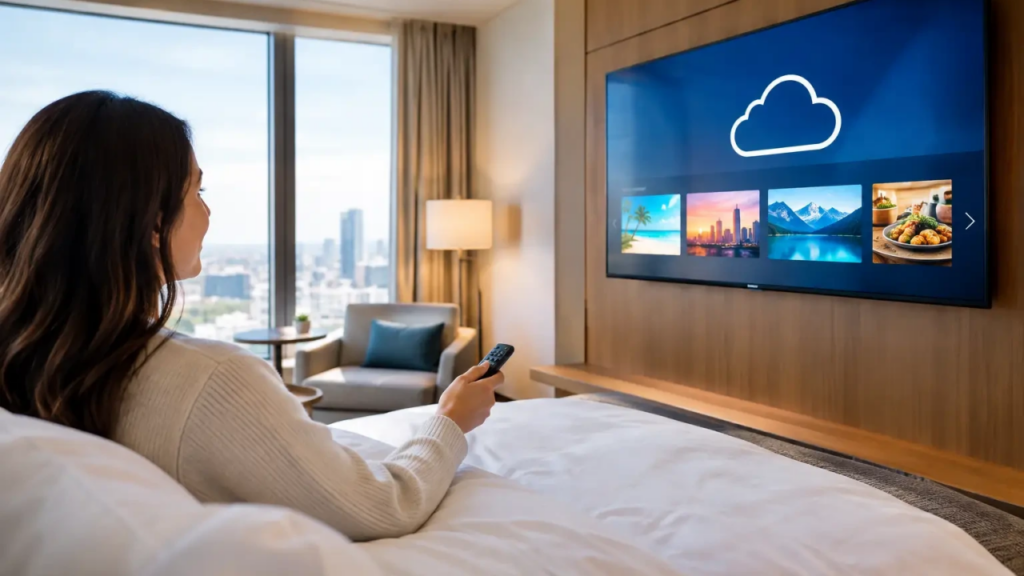
A cloud-based hotel TV platform changes the role of the screen in every room. Instead of a fixed channel guide managed through aging equipment in a back office, the TV becomes a centrally controlled guest-experience and sales channel. Your team can update content from a browser, present services that match the property brand, and give guests the streaming and casting experience they now expect.
For hotel operators, the real question is not whether television still matters. It is whether the current TV system creates work, hardware costs, and missed revenue opportunities – or supports the way the property operates today.
Turn the TV into a hotel sales channel
The TV is one of the few digital touchpoints guaranteed to be physically present in every guest room. Used well, it can guide guests toward services they may otherwise miss.
A cloud platform can promote breakfast, restaurant reservations, spa treatments, parking, late checkout, airport transfers, meeting facilities, or local experiences. With two-way PMS integration, messaging and available offers can be more closely aligned with the guest journey. A family booking, a business traveler, and a weekend leisure guest do not necessarily need the same information first.
The commercial opportunity depends on the hotel. A limited-service property may prioritize local information and late checkout. A resort may feature dining, activities, and spa offers. A full-service urban hotel may use the TV to reduce printed collateral while directing guests to high-margin amenities. The goal is not to fill every screen with promotions. It is to make the next useful action easy to find.
Viggo supports this model with a customizable hospitality TV launcher, cloud CMS, secure guest casting, IPTV and OTT compatibility, and integrations that help teams connect guest communication with hotel services.
Why traditional hotel TV systems create friction
Server-based television systems were built for a different operating model. They often require on-site servers, dedicated hardware, specialist installation, and manual configuration when content or channel lineups change. At one property, that may be inconvenient. Across a portfolio, it becomes an operational constraint.
A promotion for breakfast, a new spa package, a construction notice, or an event schedule should not require a technician visit or a complicated update process. Yet that is often the reality with legacy systems. Hotels end up leaving generic content on screens because changing it feels too slow, too expensive, or too risky.
There is also a guest expectation gap. Travelers arrive with personal streaming subscriptions, multiple devices, and an expectation of privacy. If the in-room screen cannot provide familiar content, simple navigation, and secure casting, the TV feels dated even when the room itself has been renovated.
How a cloud-based hotel TV platform works
A cloud-based hotel TV platform moves management away from an on-premise TV server and into a centralized online environment. Compatible Android TV or Google TV devices run a hospitality application that delivers the property’s interface, content, channels, and services to each room.
Hotel teams use a browser-based content management system to control what guests see. That can include the welcome screen, hotel information, digital compendium, local recommendations, channel lineup, promotional banners, room service offers, and service messages. Updates can be published across the property or targeted to a building, floor, room type, or individual room.
The result is a much lighter technology footprint. The hotel still needs reliable network design and compatible displays or streaming devices, but it does not need to maintain a traditional TV server stack simply to keep rooms current.
Central control without a complicated workflow
The strongest cloud platforms make daily content management practical for hotel staff, not just IT specialists. Marketing can schedule a weekend offer. Operations can publish a temporary message. Front desk teams can support a personalized guest welcome where the property-management-system integration supports it.
This matters because timely content has commercial value. A restaurant offer shown before dinner service is more useful than a printed card placed in a room weeks earlier. A late checkout promotion is more relevant on departure day than at check-in. The TV can respond to the guest stay, not merely display a static information page.
Content that supports the property brand
A branded launcher gives the in-room experience a clear identity from the moment the TV turns on. Colors, imagery, navigation, and promotional placement can reflect the hotel’s positioning rather than the interface of a cable provider or device manufacturer.
That does not mean every screen should become an advertisement. The best experience balances utility and promotion. Guests should quickly find live TV, streaming options, hotel information, and casting. Commercial messages should be relevant, well placed, and easy to dismiss when they are not useful.
A cloud deployment still needs a dependable network, appropriate Wi-Fi coverage, device management, and a clear support plan. Properties with unusual broadcast requirements, highly restricted networks, or legacy coaxial infrastructure may need additional integration work. But cloud delivery removes a major layer of equipment and local administration from the equation.
For a property management group, centralization is especially valuable. Brand teams can establish approved templates and shared content while individual properties retain control of their local offers. That gives the portfolio consistency without forcing every hotel to operate exactly the same way.
Secure casting is now a core guest expectation
Guests want to watch their own content. They do not want to type streaming passwords into a shared TV or worry that the next guest can access their account. Secure casting addresses both concerns when it is designed for hospitality use.
A proper hospitality casting workflow should pair a guest’s device with the room TV securely and temporarily. The guest should be able to cast from their phone or tablet without joining a confusing setup process, and the connection should end at checkout or when the guest disconnects. This is different from simply enabling consumer casting features and hoping the network setup protects privacy.
For IT leaders, the details matter: room-level pairing, network segmentation, session handling, and controlled device behavior all affect guest trust and support volume. For operations leaders, the benefit is simpler: fewer calls to the front desk and a more current in-room experience.
What to evaluate before choosing a platform
A strong product demonstration should show more than a polished home screen. Ask how quickly a new room can be deployed, how content is targeted, what happens if a device goes offline, and which team members can make updates. Confirm whether the platform works with the displays or streaming hardware you plan to use and whether it supports your IPTV, OTT, and network requirements.
Also examine the management model. Can one person manage a single independent hotel without technical training? Can a corporate team manage templates across hundreds or thousands of rooms? Can a property publish a local offer without waiting for central approval? The right answer depends on your organization, but the platform should support those choices rather than create new bottlenecks.
Security deserves the same attention. Review guest casting protections, device access controls, data handling, software update practices, and the separation between guest networks and operational systems. A simple guest experience should not come at the cost of a loose security model.
Finally, plan the rollout around operations. Start with a representative set of rooms, validate Wi-Fi performance and staff workflows, then expand in phases if needed. A platform that can be deployed room by room gives hotels more flexibility than a project that requires every room to be offline at once.
The better question to ask
The decision is not simply cloud versus server. It is whether your in-room TV can be managed at the speed your hotel operates. A platform that lets teams update every room quickly, protect guest casting, reinforce the brand, and promote relevant services turns a familiar screen into a more useful part of the property.
When the next menu changes, event begins, or guest arrives, your television experience should be ready to respond – not waiting for a server-room visit.