
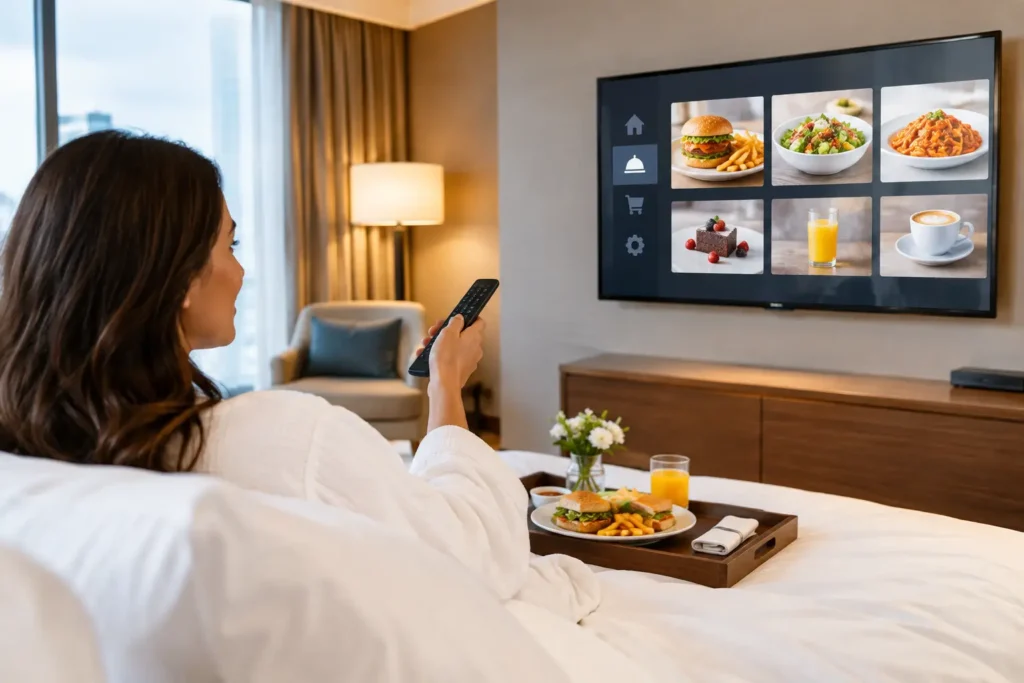
A guest has just checked in after a delayed flight. They are hungry, tired, and not interested in finding a paper menu, calling a busy line, or downloading another app. Room service ordering on TV puts the menu where their attention already is: on the largest screen in the room. For hotels, that simple shift can turn the in-room TV from a passive entertainment expense into an active sales channel.
The opportunity is not just convenience. A well-designed TV ordering experience makes it easier to surface high-margin items, promote daypart offers, reduce order friction, and keep menus current without reprinting collateral. The result is a service that feels more contemporary to guests and more manageable to operations teams.
Why Room Service Ordering on TV Works
Traditional room service depends on a sequence with too many exit points. The guest finds the menu, reads small print, calls the outlet, waits for an answer, explains the order, and may need to repeat room details. Every extra step creates a reason to abandon the purchase or choose an off-property alternative.
Ordering through the TV shortens that path. Guests browse visual categories, view item descriptions and prices, add selections at their own pace, and submit an order directly from their room. When connected to property systems and food-and-beverage workflows, the order can carry room details automatically instead of requiring staff to ask for them.
TV is particularly effective because it is available without asking guests to use a personal device. QR codes and hotel apps have a role, especially for guests on the move, but they require a phone, a scan, and often a choice to leave the hotel environment. The room TV is already switched on, branded, and positioned as a source of local service information.
This matters beyond late-night dining. The same experience can support breakfast pre-orders, poolside service, minibar replenishment, retail items, spa add-ons, and fee-based amenities. The best use case depends on each property’s operations, but the commercial principle is consistent: make the next purchase easy to find and easy to complete.
Make the TV Menu a Sales Tool, Not a Digital PDF
Putting a static room service PDF on the television is an improvement over a printed folder only in the narrowest sense. It can still be hard to read, slow to navigate, and impossible to use as an ordering interface. A TV menu should be designed for a remote control and for viewing from a bed or seating area.
Build for the 10-foot experience
Guests should be able to understand the offer in seconds. That means large type, clear categories, high-quality food imagery, concise descriptions, visible prices, and a limited number of choices on each screen. Navigation should follow familiar patterns: starters, mains, desserts, beverages, kids’ options, and dietary preferences.
Avoid trying to reproduce every detail from a restaurant menu. Television is a focused channel. Highlight the dishes that travel well, can be prepared consistently, and deliver the right margin. If the restaurant has a long menu, create a dedicated in-room selection rather than forcing guests through dozens of items with a remote.
Use merchandising deliberately
Digital ordering gives hotels control over what guests see first. A chef’s special, a wine pairing, a breakfast bundle, or a late-night comfort-food promotion can be placed where it will be noticed. Add-ons can appear at a useful moment, such as dessert after a main course or bottled water alongside a breakfast order.
That is not about pushing irrelevant offers. It is about presenting helpful choices in context. A guest ordering a burger may welcome an easy option to add fries or a local beer. A guest arriving with children may value a clearly visible kids’ meal bundle. Relevance protects the guest experience while improving average order value.
Keep availability accurate
Nothing erodes confidence faster than an item shown as available but unavailable when the kitchen receives the order. Menus need a process for updating sold-out items, outlet hours, service restrictions, and temporary promotions. If breakfast ends at 11 a.m., the TV should stop taking breakfast orders at 11 a.m.
Cloud-based content management is useful here because authorized staff can make changes from a browser rather than waiting for a technical update on every screen. That speed supports daily operations, not just seasonal campaigns.
The Operational Requirements Behind a Good Guest Experience
The guest-facing screen is only one part of the decision. Hotel leaders should assess what happens after the guest presses Submit. Room service ordering succeeds when the order reaches the right team, contains the right information, and fits existing service standards.
At a minimum, the workflow should confirm the room number, order details, delivery instructions, and estimated timing. Properties also need a clear approach to payment. Some hotels will post charges to the room through PMS integration; others may use a payment flow that meets their operating model. The right choice depends on property configuration, local requirements, and the systems already in place.
Kitchen routing also deserves early attention. A direct connection to a point-of-sale system may be appropriate for high-volume food-and-beverage operations. Smaller properties may begin with a monitored order dashboard, email notification, or printed ticket workflow. The goal is not to add complexity. It is to remove manual handoffs that cause errors and delay.
Staff ownership matters as much as integration. Decide who updates menus, who monitors incoming orders, who resolves substitutions, and who changes service hours. A polished digital menu cannot compensate for an unstaffed outlet or unclear fulfillment process.
TV Ordering Compared With Traditional Room Service
| Capability | Phone and printed menu | Room service ordering on TV | |—|—|—| | Menu updates | Reprint menus and replace in rooms | Update content centrally as offers change | | Guest ordering path | Call, wait, explain, and confirm | Browse, select, and submit from the room | | Upsell opportunities | Dependent on staff conversation | Featured items and relevant add-ons on screen | | Brand presentation | Often inconsistent or outdated | Branded visuals, messaging, and promotions | | Reporting potential | Manual review and limited context | Track views, selections, and order behavior | | Scale across rooms | Labor-intensive to maintain | Publish changes across the property remotely |
The comparison is not an argument for removing human service. A guest may still want to call with a special request, and premium hotels may want staff interaction as part of the experience. TV ordering should give guests a fast default path while leaving room for personal assistance when it adds value.
Integration Should Reduce Work, Not Create More
A common concern is that another digital ordering channel will create another system for staff to manage. That concern is valid when the TV platform is isolated from property operations. The better approach is to treat TV as a front-end channel connected to the tools teams already rely on.
PMS integration can personalize the experience, identify the occupied room, and support room-charge workflows. Food-and-beverage integration can send orders where they need to go. Centralized content controls can keep the guest-facing experience aligned with the property’s brand and service schedule.
Viggo Smart TV supports this model by combining a cloud-managed hospitality TV experience with e-commerce capabilities and two-way PMS integration. Rather than relying on an on-premise TV server, teams can manage content and promotions centrally, helping hotels update guest offers without treating every room television as a separate project.
For multi-property operators, consistency is a major advantage. Corporate teams can establish approved templates, menu rules, and campaign assets while individual hotels retain control over local pricing, availability, and outlet hours. That balance prevents brand drift without forcing every property into the same food-and-beverage strategy.
How to Launch Without Disrupting Service
A practical rollout starts with one question: which guest purchase is easiest to improve first? For many hotels, that is a concise late-night menu or a breakfast pre-order experience. These use cases have clear demand, limited menus, and measurable results.
Start by mapping the current order journey. Identify where guests give up, where staff repeat information, and where menus become outdated. Then define a small, high-confidence digital menu with accurate descriptions, clear availability, and a reliable fulfillment process.
Before a full-property launch, test the experience in a controlled group of rooms. Ask front desk, room service, and kitchen teams to place test orders at different times of day. Confirm that notifications arrive, room details are correct, charges post as expected, and staff know what to do when an item is unavailable. This is also the right time to test the guest language and visual design from the sofa, using the actual remote.
Measure results after launch. Look at order volume, average order value, most-viewed categories, abandoned baskets if available, fulfillment times, and guest feedback. If a featured bundle earns attention but few orders, the price, imagery, or value proposition may need adjustment. If a category is rarely opened, it may not belong on the first screen.
Protect the Guest Experience
The strongest TV commerce programs feel useful, not intrusive. Do not interrupt entertainment with repeated sales messages or make guests navigate through promotions before they can access television. Give the ordering option a visible home on the hospitality launcher, support it with relevant in-stay messaging, and let guests choose when to engage.
Accessibility also deserves consideration. High contrast, readable text, logical navigation, and simple language help a wider range of guests use the service independently. Hotels serving international travelers may need multilingual content, while resorts may want menus that reflect dietary needs and family travel patterns.
Privacy and security are equally practical requirements. Guests should not see another room’s order history or personal details, and staff should have role-appropriate access to manage content and fulfillment. A centrally managed platform makes it easier to maintain these controls consistently across rooms.
A room-service menu on TV is most valuable when it solves a real guest need at the exact moment that need appears. Start with an offer your team can deliver well, make every screen easy to act on, and keep improving it from the data guests provide with every order.