
A hotel TV server rarely fails at a convenient time. It becomes a problem during a sold-out weekend, after a channel lineup change, or when staff need to update a promotion across 200 rooms before check-in. For operators looking to replace legacy hotel TV servers, the real goal is not simply newer technology. It is removing a recurring operational burden while making every in-room screen easier to manage, brand, and monetize.
Server-based hotel TV systems were built for a different operating model. They often depend on local hardware, specialist configuration, manual updates, and a network design that is difficult to change once installed. Cloud-managed TV platforms shift control from the equipment room to a browser-based dashboard, giving hotel teams a faster way to operate the guest TV experience.
Why Replace Legacy Hotel TV Servers?
The case for replacement usually begins with maintenance, but it quickly expands into guest experience and commercial performance. An aging headend or on-premise TV server can require dedicated space, cooling, power, backup planning, patching, and outside support when something goes wrong. If a single component fails, an entire floor or property may be affected.
The cost is not only technical. A traditional system can make simple content changes unnecessarily slow. Updating a welcome screen, adding a restaurant promotion, changing the spa hours, or promoting late checkout may require someone with access to the server or a vendor service call. That limits the TV to a passive channel lineup instead of a practical guest communications and sales channel.
A modern cloud platform removes the need for a local TV application server while centralizing control of the experience. Hotel teams can manage branding, menus, content, apps, and messages from one place. Updates can be scheduled, targeted by room or group, and applied without visiting individual rooms.
This is especially valuable for multi-property groups. Brand teams can maintain approved layouts and campaigns centrally, while each property retains control of its own local offers, service information, and guest communications.
What Changes When the Server Is Gone
Replacing a legacy system does not mean eliminating every piece of infrastructure. TVs, network connectivity, content sources, and property controls still matter. The difference is where the intelligence lives and how much hardware the hotel must maintain.
With a cloud-managed Android TV or Google TV deployment, the in-room application is installed on compatible hospitality TVs, streaming devices, or other approved endpoints. The platform connects those devices to centrally managed content and settings. Rather than operating a local server that distributes the television experience, the hotel manages devices through the cloud.
That change creates several practical advantages. Property teams can deploy branded interfaces room by room, roll out updates across the building, and view device status without waiting for a technician to access the equipment room. For a renovation or phased refresh, rooms can be upgraded in stages instead of holding the entire project until every television is replaced.
Guest casting can also become easier to offer securely. The right casting approach keeps each guest session isolated, so personal content is not exposed to the next room occupant. This matters because casting is now a familiar expectation for many travelers, but it must be implemented with clear room association, session controls, and network planning.
The TV becomes a hotel touchpoint
A modern hotel TV interface should do more than display channels. It can greet guests, present property information, promote dining and amenities, explain Wi-Fi access, and surface local recommendations. With two-way property-management-system integration, hotels can personalize elements of the experience while keeping the workflow tied to operational data.
The commercial opportunity is straightforward. A guest who sees breakfast details, a restaurant offer, a spa promotion, or an upgrade option on the TV is seeing it at a relevant moment – in the room, on property, and often before making a plan. The screen becomes a direct channel for ancillary revenue, not an underused fixture on the wall.
Server-Based TV vs. Cloud Management
| Operational area | Legacy server-based system | Cloud-managed TV platform | | — | — | — | | Core infrastructure | On-premise server and supporting hardware | No local TV application server required | | Content updates | Often manual or vendor-dependent | Managed remotely through a browser-based CMS | | Deployment | Hardware configuration can slow room rollout | Rapid deployment by room, floor, or property | | Brand control | Changes may be limited by system configuration | Central templates, branded launchers, and scheduled campaigns | | Scale | More infrastructure planning as device counts grow | One platform can manage from a single installation to thousands of screens | | Guest services | Primarily channel delivery | TV, casting, information, promotions, and service commerce |
The table does not mean every hotel should replace its TV environment immediately. A recently installed system with reliable support and a long remaining hardware life may justify a measured transition. But if the current platform is difficult to update, unsupported, expensive to maintain, or unable to support the guest services the hotel wants to offer, postponing a change can cost more than the replacement project.
Build a Practical Replacement Plan
A successful migration starts with an audit, not a product decision. Identify the televisions and devices currently in use, their operating systems, network connections, channel sources, existing middleware, and any dependencies on PMS, Wi-Fi, or casting tools. This reveals whether the project can use existing screens, requires new compatible devices, or should be phased with a planned TV refresh.
Next, define the guest and business outcomes. A boutique hotel may prioritize a distinctive branded launcher, local recommendations, and casting. A large resort may need campaign scheduling, dining promotions, multilingual content, and integration with property systems. A multi-property group may place the highest value on centralized governance and consistent brand presentation.
Network readiness deserves careful attention. Cloud management reduces local server complexity, but it does not eliminate the need for a stable guest network. Hotels should evaluate Wi-Fi coverage, wired connections where applicable, VLAN design, bandwidth, device isolation, and how guest casting will be associated with the correct room. IT teams and hospitality technology integrators should be involved early, especially where existing IPTV or CATV services must continue alongside new applications.
Then build the content before deployment. The strongest launchers are clear and useful, not overloaded with tiles. Start with the services guests use most: live TV or streaming access, casting instructions, hotel information, dining, amenities, and help. Add promotions where they make sense in the guest journey. An offer for room service after evening arrival, for example, will generally perform better than a generic promotion displayed all day.
Roll out in stages when risk is high
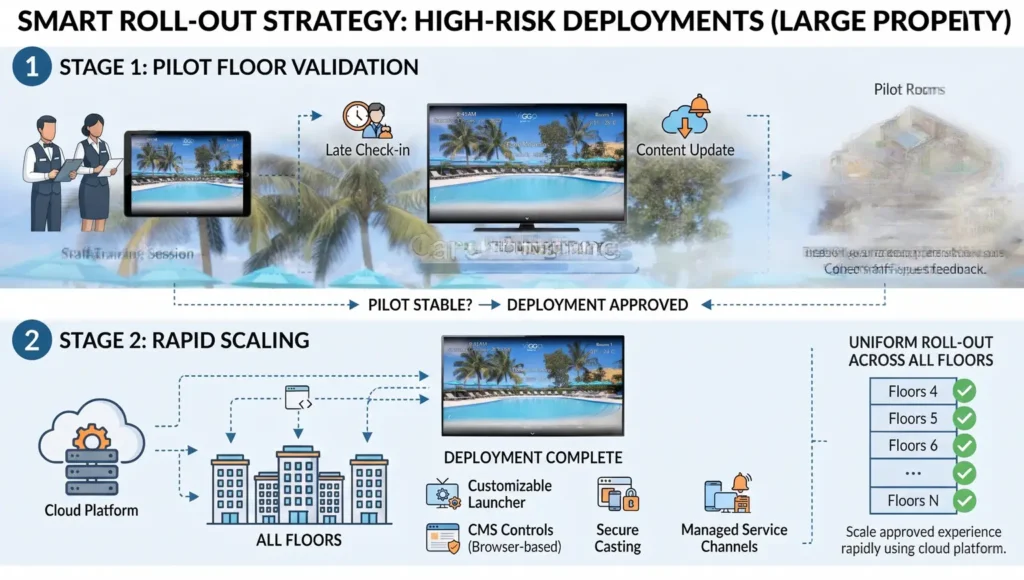
For a large property, a pilot floor is often the smartest approach. It lets the hotel validate network performance, train staff, test room turnover workflows, and collect feedback before scaling. The pilot should include different room types and real operational scenarios, including a late check-in, a casting session, a channel change, a content update, and a guest request for support.
Once the pilot is stable, deployment can move quickly. A cloud platform makes it possible to apply the approved experience across rooms without repeating server-side configuration at every stage. Viggo Smart TV is designed for this model, combining a customizable hospitality TV launcher, browser-based CMS controls, secure guest casting, and integrations that help properties turn screens into managed guest-service channels.
Questions Hotel Teams Ask Before Replacing a TV Server
Can we keep our existing TV service?
Often, yes. The answer depends on the current service provider, television hardware, signal delivery method, and the platform selected. A replacement project can preserve IPTV, OTT apps, CATV content, or a mix of sources when the new environment is planned around the property’s requirements. Confirm compatibility during the technical assessment rather than assuming every existing component will transfer unchanged.
Will staff need specialist training?
Daily users should not need server administration skills. Front office, marketing, and operations teams need a clear process for changing approved content, scheduling messages, and checking that rooms are online. The best implementation includes onboarding, role-based access, and a simple ownership model for content so the platform stays current after launch.
Is cloud management less reliable than an on-premise server?
Reliability depends on the full design, including internet connectivity, the local network, device management, content sources, and support processes. Cloud management removes a local single point of maintenance, but hotels should still plan for network resilience and define what guests see if connectivity is temporarily interrupted. Ask providers how devices behave offline, how updates are managed, and what monitoring is available.
A hotel TV replacement is most valuable when it gives the property more control, not more work. Start with the guest moments and operational bottlenecks you want to improve, then choose an architecture that lets your team act on them quickly – room by room, campaign by campaign, and property by property.