A guest checks in after a delayed flight, enters the room, and sees their name on the TV along with the correct checkout date, Wi-Fi details, and restaurant hours. That experience does not require a front-desk call or a printed welcome sheet. The language? Either set by the guest’s nationality at check in (over 170 fully supported) or selected by the guest – either at check-in or in-room. PMS integration for hotel TV makes the room screen aware of the guest journey, turning a standard display into a useful hospitality touchpoint.
For hotel operators, the value goes beyond a better welcome message. A connected TV can reduce repetitive questions, promote services when they are most relevant, and help every room present accurate information without manual updates. The result is a guest experience that feels more considered while giving operations and commercial teams a channel they can manage at scale.
What PMS Integration for Hotel TV Actually Does
A property management system holds the core data behind a guest stay: reservation status, room number, check-in and check-out dates, guest name, and sometimes language or loyalty details. When the hotel TV platform connects to the PMS, it can use approved data to change what appears on the in-room screen.
The most visible use is personalized greeting. Once a guest has checked in, the TV can display their name and stay information instead of a generic welcome screen. At checkout, the experience can automatically reset so the next arrival does not see information left behind from the previous stay.
That automation matters operationally. Without PMS connectivity, staff may need to assign guest details manually, rely on a generic TV interface, or accept that room screens remain out of date when a guest extends a stay, changes rooms, or checks out early. A two-way integration keeps the TV experience aligned with the system the property already uses to manage occupancy.
The exact data available depends on the PMS, its interface capabilities, and the hotel’s privacy policy. A well-designed implementation uses only the information required to improve the in-room experience. The goal is relevance, not unnecessary data exposure.
Why Connected Hotel TVs Improve Daily Operations
A hotel TV is one of the few digital channels guaranteed to be inside every occupied room. Unlike a pre-arrival email, it is available when guests are deciding where to eat, whether to book a treatment, or how to request a late checkout. PMS data gives that channel context.
For example, a guest who has just arrived may see breakfast times, property navigation, and a room service prompt. A guest on the final evening of a stay may see checkout guidance, airport transfer options, or an invitation to join the loyalty program. The content is still controlled by the hotel, but it is delivered at a more useful point in the stay.
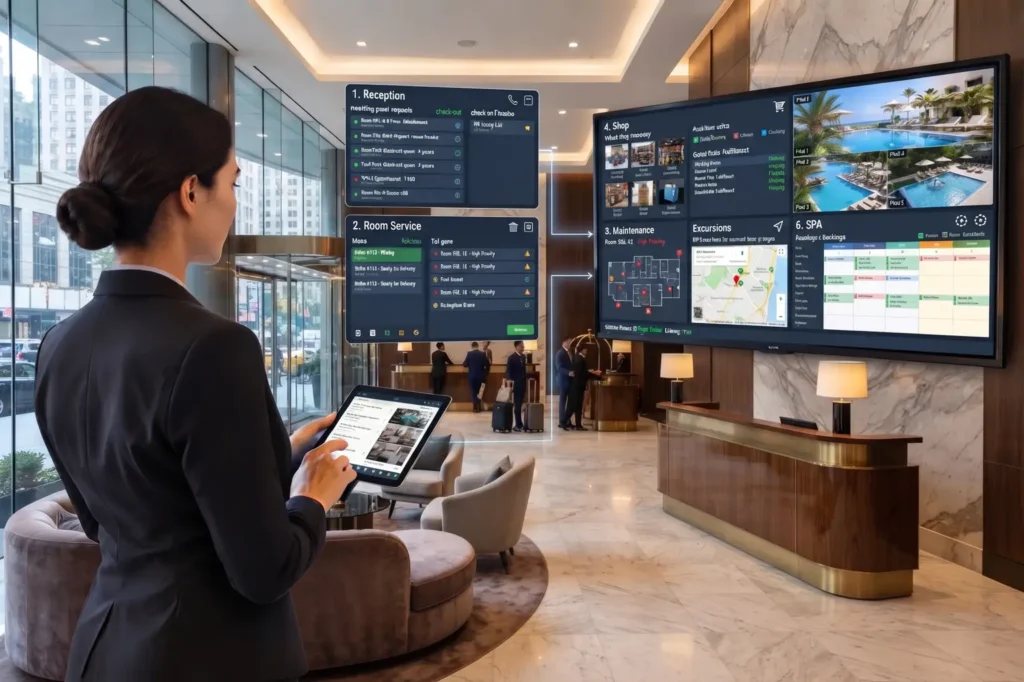
This also reduces pressure on the front desk. Guests can confirm checkout time, find dining hours, review hotel amenities, and access local information from the TV rather than calling for basic details. The benefit is especially noticeable at large properties, resorts, and hotels with lean staffing during evening hours.
For multi-property groups, connected TV also supports consistency. Brand teams can distribute approved campaigns across locations while each property keeps local details such as restaurant menus, meeting room information, parking instructions, and seasonal offers current.
The Commercial Case: Make the Room Screen a Sales Channel
Hotels often treat in-room TV as a cost center: a required amenity that must provide live channels and entertainment reliably. PMS integration changes that view. It gives the hotel a practical way to present relevant offers to confirmed, in-house guests.
A generic promotion can still work, but timing and context improve its value. Restaurant specials are more effective when shown before dinner. Spa availability is more useful during a leisure stay. Late checkout offers should appear before departure day, not after the guest has left. The PMS provides the stay status that helps schedule these messages intelligently.
This does not mean every screen should become an advertisement. Overpromotion can make the experience feel cheap and distract from the content guests actually need. The strongest approach uses a clear, branded home screen with useful information first, then places offers where they fit naturally in the guest journey.
A cloud-managed platform gives commercial teams control without requiring an engineer to update each room. With Viggo Smart TV, hotel teams can manage branded content centrally and distribute it quickly across a property, without relying on an on-premise TV server.
What a Good Integration Should Handle
Not all PMS integrations are equal. Before selecting a hotel TV platform, operators should look beyond the phrase “PMS compatible” and ask what happens during the full guest lifecycle.
At a minimum, the integration should recognize check-in, check-out, room moves, stay extensions, and cancellations. A room move is a useful test case: when the PMS assigns the guest to a new room, the old TV should clear its guest session and the new room should display the correct welcome experience promptly.
The integration should also define what happens when the PMS connection is temporarily unavailable. Live TV, apps, general hotel content, and core guest functions should remain usable. Once connectivity is restored, the platform should reconcile the latest room status rather than leaving stale personalization on screen.
Security deserves the same level of scrutiny. Guest identity data should be minimized, protected in transit, and removed at checkout. Staff permissions should limit who can change integrations, edit guest-facing content, or access reporting. For hotels offering casting, the TV platform should ensure guests can only connect to the screen assigned to their active room.
Cloud Platform vs. Server-Based TV Architecture
PMS integration can work in either a server-based or cloud-managed TV environment, but the operating model is different. Traditional systems often place a dedicated server on property. This can be familiar to IT teams, particularly at older installations, but it adds hardware, maintenance, replacement planning, and potential points of failure.
| Consideration | Server-based hotel TV | Cloud-managed hotel TV | | — | — | — | | Content updates | Often depend on local systems or specialist support | Managed remotely through a browser-based CMS | | Hardware footprint | Requires on-property server equipment | No dedicated TV server required | | Multi-property control | Can require separate management by location | Centralized management across properties | | Software updates | Planned locally and may involve site work | Delivered remotely as part of the platform | | Scaling rooms | May require capacity planning and additional hardware | Designed to expand from a few rooms to thousands |
Cloud architecture is not automatically the right answer for every property. A hotel with strict local-network policies, unusual legacy equipment, or limited internet resilience may need additional design work. The point is to evaluate the full operating cost, not just the initial installation price. A lower-cost system can become expensive if every content change, software update, or troubleshooting task requires an on-site visit.
Implementation: Get the Details Right Before Go-Live
Successful PMS integration begins with a clear mapping of systems and responsibilities. The hotel should identify its PMS version, available interface method, network requirements, TV hardware, and the guest data fields the TV platform will use. IT, operations, front desk leadership, and the PMS provider should agree on those details before installation begins.
Testing should mirror real hotel activity, not just a single successful check-in. Test early arrivals, no-shows, room changes, back-to-back reservations, extensions, group blocks, and checkout. Confirm the TV resets correctly after each scenario. It is easier to resolve edge cases before the system reaches every room.
Content preparation is equally practical. The welcome screen needs current branding, but the most useful content is often simple: dining hours, service instructions, property information, casting guidance, accessibility details, and clear routes to book or order. Keep the home screen focused. Guests should not need to work through several menus to find the information that helps them immediately.
Questions to Ask a Hotel TV Provider
Ask whether the integration is two-way or limited to one-way guest data display. Confirm which PMS events trigger updates, how long updates typically take, and how the provider handles failed connections. Also ask who owns implementation, what support is available during go-live, and whether content can be updated by hotel staff without vendor intervention.
These questions separate a basic technical connection from an operational tool the property can rely on every day.
FAQ
Does PMS integration require guest names on the TV?
No. Personalized greeting is optional. Some hotels prefer to show only room-specific stay details or a generic welcome screen. The configuration should reflect the property’s brand standards and privacy approach.
Can PMS-connected TVs support room service and amenity sales?
Yes, when the TV platform includes e-commerce or links to the property’s ordering workflow. PMS stay data can help ensure requests and charges are associated with the correct occupied room, subject to the connected systems and hotel process.
Is PMS integration only useful for large hotels?
No. Larger properties may see more immediate efficiency gains because of room volume, but independent hotels benefit too. A small team can keep every room screen accurate, branded, and current without spending time updating individual devices.
The best PMS-connected TV experience does not call attention to the integration behind it. Guests simply find the right information at the right time, while hotel teams gain a practical channel for service, communication, and revenue. That is a meaningful upgrade for every room, not another system for staff to manage.